


Why your business isn’t showing up in ChatGPT may have nothing to do with the quality of your website. You have a website. It looks professional. You’ve done some SEO. And yet, when someone asks ChatGPT to recommend businesses in your niche, your name never appears.
The reason is simple: AI systems don’t evaluate businesses the same way traditional search engines do. Instead of relying primarily on keyword rankings, they use a confidence model built around entity authority, trust signals, topical expertise, and structured data.
Your business isn’t showing up in ChatGPT — not because you’re unknown, but because AI systems use a completely different confidence model than traditional search engines. That distinction is what most businesses still haven’t grasped.
Here’s something that surprises most business owners: smaller, lesser-known brands regularly get cited by Gemini, Perplexity, and ChatGPT while established companies with polished websites stay completely invisible. The difference isn’t size. It isn’t budget. It’s whether the AI system has enough structured signals to confidently recognize and recommend that business.
Many business owners ask why their business isn’t showing up in ChatGPT despite investing heavily in SEO and content marketing.
Understanding why your business isn’t showing up in ChatGPT requires looking beyond traditional ranking factors.
The biggest reason why your business isn’t showing up in ChatGPT is that AI systems rely on entity confidence rather than keyword rankings.
If you’re wondering why your business isn’t showing up in ChatGPT, the fixes in this guide will help improve your AI visibility over time.
By the end of this guide, you’ll understand exactly why that gap exists, which specific signals AI systems use to evaluate businesses, and the concrete steps to fix your discoverability — starting today.
Why AI Search Engines Evaluate Businesses Differently Than Google Does
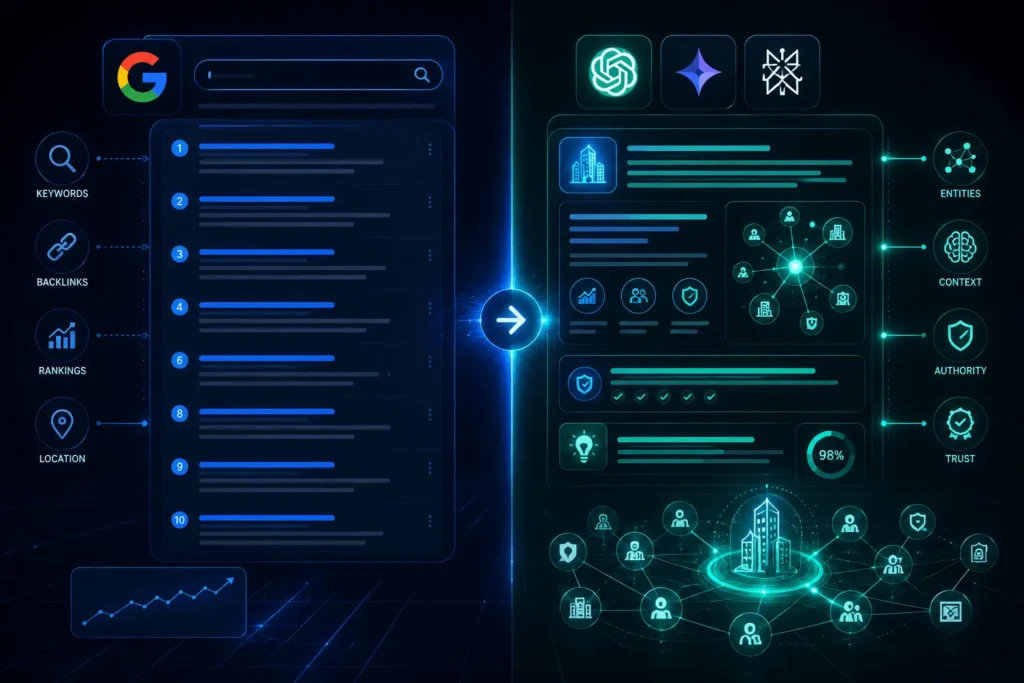
Traditional SEO operated on a relatively simple logic: publish pages, earn backlinks, target keywords, move up the rankings. Google’s algorithm, at its core, counted and weighed signals attached to individual pages.
AI search works on a fundamentally different model.
Systems like ChatGPT, Gemini, and Perplexity don’t rank pages — they build answers. And to build an answer, they need confidence. Confidence that a business is real, legitimate, contextually relevant, and recognized by the broader web ecosystem.
This means AI systems are constantly evaluating questions that have nothing to do with keyword density:
- Is this business a recognizable entity with a clear identity?
- Do authoritative sources reference or mention it?
- Is its information consistent across platforms?
- Does it demonstrate expertise in a specific niche?
- Do real people discuss it online?
The shift is from keyword-first to confidence-first.
This shift explains why your business isn’t showing up in ChatGPT even when your website ranks well in traditional search engines.
A business can have every keyword perfectly placed and still remain invisible inside AI-generated answers — because the AI doesn’t trust it enough to recommend it. That’s the gap that entity SEO, GEO optimization, and AEO strategy are designed to close.
The internet is transitioning from a keyword-first system to a context-first system. AI search accelerates that transition significantly.
Why Your Business Isn’t Showing Up in ChatGPT: The Real Reason

Many businesses assume their website is “good enough” because it looks clean and loads quickly, but that’s often why your business isn’t showing up in ChatGPT despite having a professional online presence.
If a website is technically weak, AI systems struggle to understand it. And what an AI can’t understand, it won’t confidently recommend.
Common structural problems that directly harm AI discoverability include missing XML sitemaps, absent or broken schema markup, poor internal linking architecture, weak or missing metadata, broken indexing signals, and missing files like robots.txt and llms.txt.
Does Schema Markup Actually Help With ChatGPT Visibility?
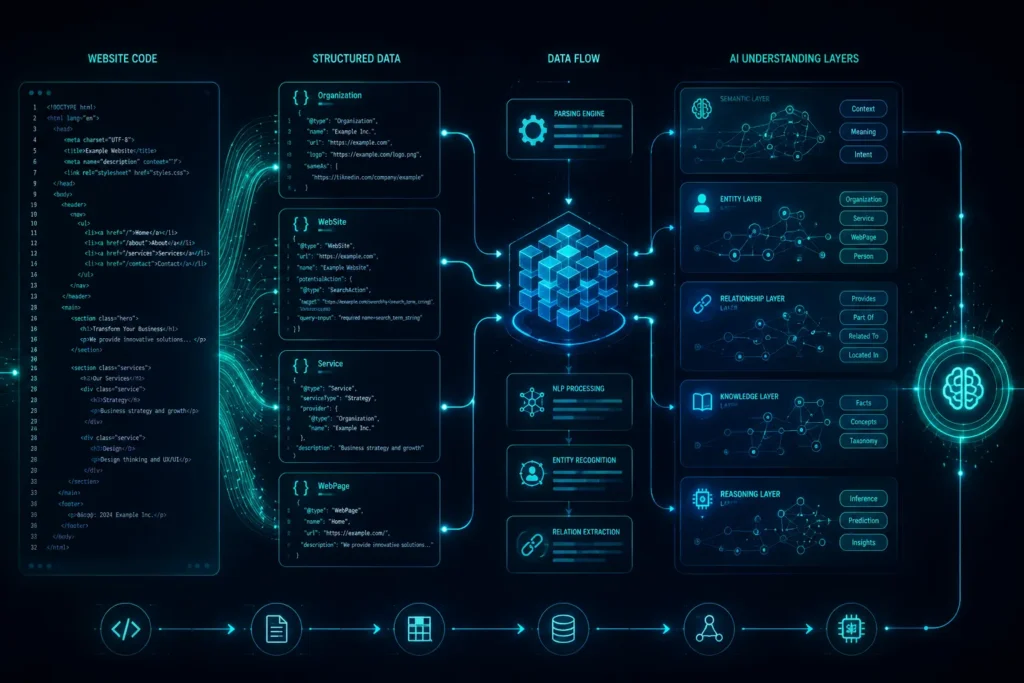
Yes — significantly. Schema markup is structured data that tells search engines and AI systems precisely what your content means, who you are, and what you offer. Without it, AI systems must guess. And AI systems don’t recommend businesses they’re guessing about.
At minimum, every business website should properly configure:
- Google Search Console and Bing Webmaster Tools (to ensure indexing)
- XML sitemap (to guide crawlers through all important pages)
- robots.txt (to clarify what should and shouldn’t be indexed)
- Schema markup (Organization, LocalBusiness, FAQ, and Article schemas as relevant)
- Canonical tags (to eliminate duplicate content confusion)
- Open Graph metadata (for accurate social and AI platform previews)
- IndexNow (to notify search engines immediately when content updates)
- llms.txt (an emerging standard that tells AI crawlers what to prioritize)
Most businesses skip half of these. Technical SEO is no longer just ranking infrastructure. It is discoverability infrastructure for the AI-first web.
Why Your Business Isn’t Showing Up in ChatGPT Even With Good SEO

This is the deepest reason most businesses remain invisible in ChatGPT — and the most misunderstood one.
AI systems don’t just look at your website. They look for your entity — a consistent, coherent digital identity that appears reliably across multiple authoritative surfaces. The more consistently an entity is described and referenced across the web, the higher the AI system’s confidence in recommending it.
Here’s where it gets interesting: inconsistency actively damages your AI visibility.
If your LinkedIn says you’re an “AI automation agency,” your website calls you a “digital marketing consultancy,” your Crunchbase profile says “tech startup,” and your Twitter bio offers no description at all — AI systems receive fragmented, contradictory signals. They lose confidence in what you actually are. And low-confidence entities don’t get recommended.
What Does Consistent Entity Authority Actually Look Like?
Strong entity SEO means your business identity aligns clearly across every surface that AI systems can access:
- LinkedIn company page — clear niche, description, and positioning
- Primary website — consistent messaging that matches all other platforms
- Business directories — same name, address, category everywhere
- Medium, Substack, or industry publication profiles — same expertise framing
- YouTube channel (if applicable) — consistent with your stated expertise
- Author bios on guest posts — always pointing back to your core entity
- Crunchbase or AngelList — if relevant to your industry
Most people assume X — that more content automatically builds entity authority. But content that contradicts your core positioning actually weakens it. One hundred blog posts about unrelated topics signals an unfocused, low-authority entity to an AI system.
Strong entity authority is about clarity, not volume.
In fact, weak entity consistency is one of the biggest reasons why your business isn’t showing up in ChatGPT when users search for recommendations in your niche.
How Contextual Brand Mentions Signal Legitimacy to AI Models
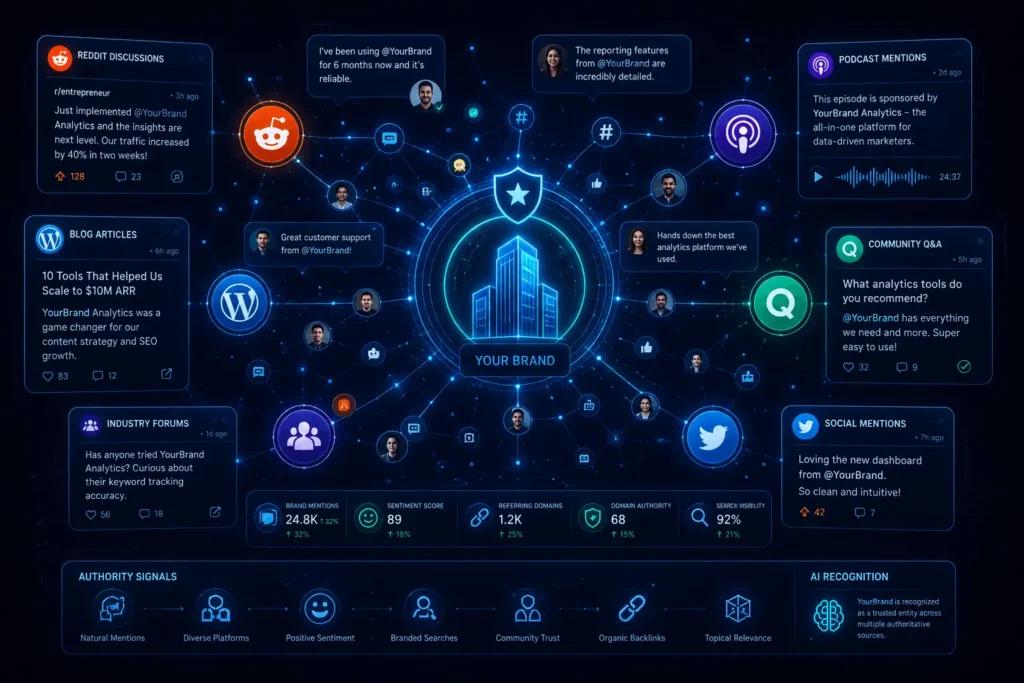
Backlinks have long been the dominant currency of SEO. But AI systems operate with a richer trust model — and one of its most powerful signals is something many businesses aren’t building at all: contextual brand mentions.
When people naturally reference your business in Reddit threads, Quora answers, podcasts, niche blogs, industry comparison articles, or even community forums — AI systems observe that. They interpret organic mentions as legitimacy signals. A business being discussed is a business being recognized.
Mentions create confidence. Confidence creates recommendations.
This is a meaningful shift from traditional link-building strategy. A dozen genuine mentions in relevant niche communities can carry more AI discoverability weight than a hundred low-quality backlinks. The relevance and naturalness of the mention matters more than the raw link.
Why Niche Communities Matter More Than Mass Platforms
A mention in a specialized cybersecurity forum carries far more entity relevance for a cybersecurity company than a general business directory listing. AI systems understand semantic context — they recognize that a mention in a relevant community indicates genuine recognition within a specific domain.
Practical approaches include: answering questions on Quora and Reddit in your area of expertise, contributing guest insights to industry newsletters and publications, participating actively in niche communities where your customers spend time, and earning coverage through digital PR in industry-specific media.
Each of these creates the kind of distributed, contextual web presence that AI systems are designed to recognize and trust.
How Topical Authority Determines Whether AI Systems Recommend You
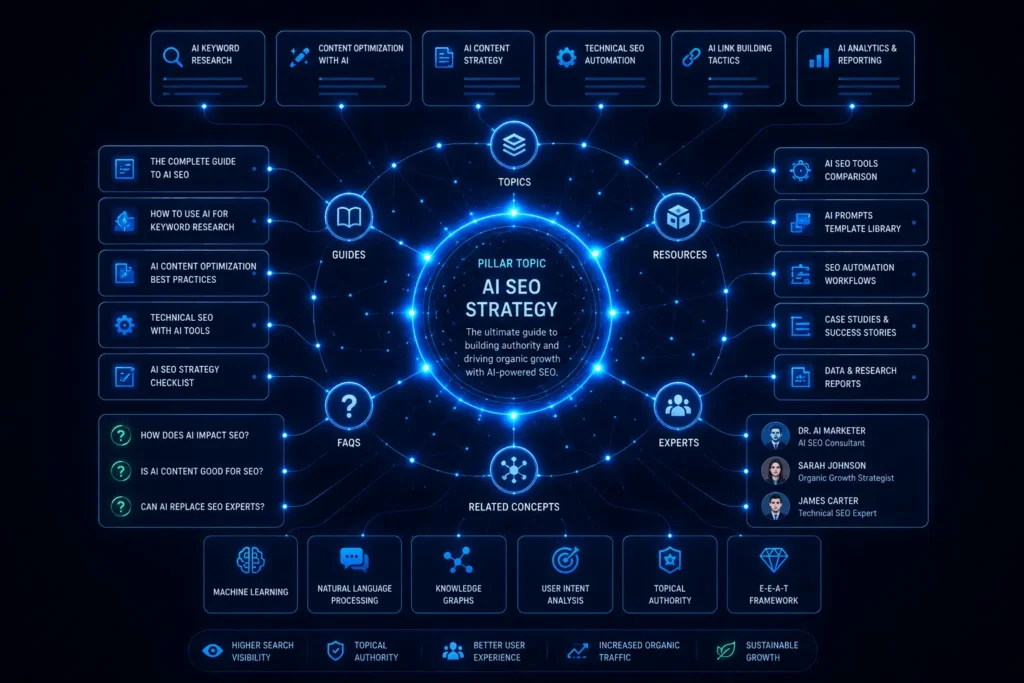
One homepage is not authority. Neither are five service pages.
AI systems are increasingly sophisticated about assessing genuine domain expertise. A single website that says “we do cybersecurity” in a few paragraphs generates weak expertise signals. A cybersecurity company that has published ransomware prevention guides, cloud security explainers, compliance framework breakdowns, incident response checklists, and attack vector analyses generates something entirely different.
That body of content signals to AI systems: this entity knows this domain deeply.
For many brands, this is exactly why your business isn’t showing up in ChatGPT despite having a well-designed website and active marketing efforts.
Topical authority is built through a content ecosystem — not individual pieces of content, but a coherent network of content that covers a subject area from multiple angles. The more completely you cover your niche, the more an AI system can identify you as a trusted resource within it.
What Topics Should You Actually Build Content Around?
Focus on the questions your ideal customers are actually asking — not just sales-driven topics. Educational content that genuinely helps people understand your domain builds far stronger AI topical signals than promotional content does.
For example, a GEO and AI visibility consultancy should publish content covering:
- What GEO optimization is and why it differs from traditional SEO
- How AI search engines evaluate business entities
- Why some brands appear in Perplexity but others don’t
- How to structure content for AI consumption
- The difference between AEO and traditional FAQ strategy
Each piece contributes to a growing topical footprint that AI systems recognize and cite. ReFlowNix‘s approach to content strategy is built entirely around this model — topical authority compounds over time, and each article strengthens the entity’s overall AI visibility.
What the FSA Framework Reveals About AI Discoverability
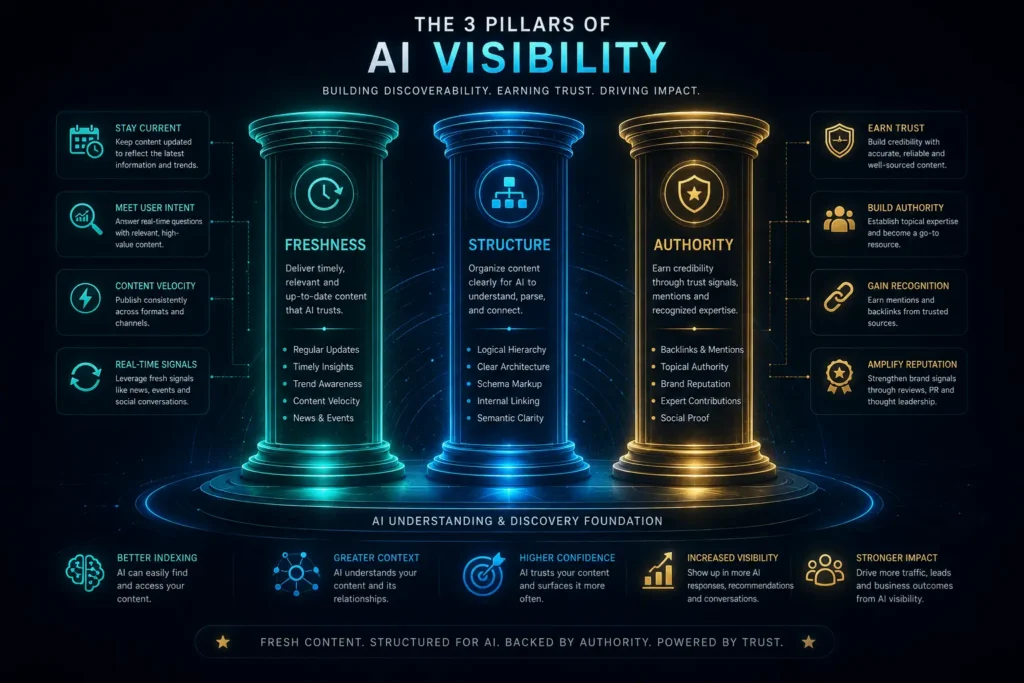
Understanding modern AI discoverability becomes clearer through a practical mental model: the FSA Framework. It maps the three dimensions AI systems use to evaluate whether a business deserves to appear in generated answers.
F — Freshness
AI systems prefer actively maintained entities. An abandoned website or a LinkedIn page last updated two years ago sends a signal that the entity may no longer be relevant or operational. Freshness signals include recently updated content, new mentions accumulating across the web, active publishing cadences, and current factual information across all platforms.
Freshness doesn’t mean posting daily. It means demonstrating active, ongoing relevance in your domain.
Businesses wondering why your business isn’t showing up in ChatGPT often discover that outdated content and inactive profiles are reducing AI confidence.
S — Structure
Structure reduces ambiguity — and AI systems avoid recommending ambiguous entities. A well-structured digital presence helps AI models understand exactly what you do, who you serve, and how you relate to your industry.
Structure includes: proper schema markup, clean site architecture, meaningful internal linking, accurate metadata, and semantic content organization. A well-structured website doesn’t just rank better — it gets understood faster by AI systems.
A — Authority
Authority in the AI era isn’t just about backlinks. It’s about the cumulative weight of your entity’s footprint across the internet. Relevant backlinks still matter — particularly from industry-specific publications. But entity mentions, brand citations, niche community recognition, and expert content all compound into a broader authority signal that AI systems evaluate holistically.
Here’s where most businesses fundamentally misunderstand AI visibility: AI systems aren’t evaluating just your website. They’re evaluating your entire digital presence. Your website is one data point in a much larger picture.
What Businesses Must Do Right Now to Appear in AI Search
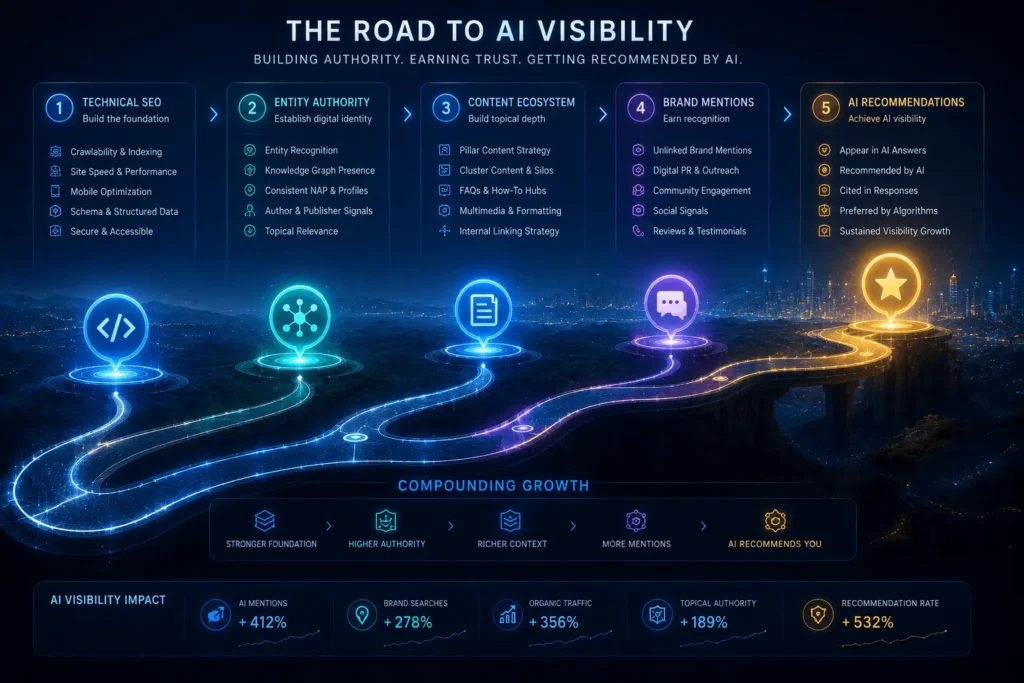
Understanding why the problem exists is useful. Knowing what to do about it is what matters. Here are the most impactful actions, in order of priority:
1. Audit and Fix Technical SEO Infrastructure Before anything else, ensure your website is properly crawlable and structured. Set up Google Search Console and Bing Webmaster Tools. Validate your XML sitemap. Add Organization schema markup. Configure robots.txt and llms.txt. Verify canonical tags on all key pages. Without this foundation, everything else works at reduced effectiveness.
2. Establish Consistent Entity Identity Across Platforms Audit every platform where your business appears. Standardize your business name, niche description, positioning, and service framing everywhere. Choose a clear, specific identity — not “we help businesses grow” but “we help B2B SaaS companies build AI search visibility through GEO and entity SEO strategies.” Specificity builds entity clarity. Entity clarity builds AI confidence.
3. Build a Topical Content Ecosystem Map the core questions in your niche and begin systematically answering them through well-structured articles, guides, FAQs, and explainers. Prioritize question-based and conversational content formats. AI search is fundamentally conversational — content that directly answers specific questions gets extracted and cited far more frequently than generic promotional copy.
4. Develop a Brand Mention Strategy Identify the niche communities, publications, and platforms where your customers and peers spend time. Contribute meaningfully — answer questions, share expertise, participate in discussions. Digital PR that earns mentions in relevant industry media is particularly powerful. The goal is distributed presence, not just backlinks.
5. Publish Content Formatted for AI Extraction Structure your content with clear heading hierarchies, concise definitions, direct answer paragraphs, FAQ sections, and numbered lists where appropriate. AEO (Answer Engine Optimization) isn’t about gaming AI — it’s about making your content easy for AI systems to parse and reference accurately. Lead with the answer, then explain.
Why AI Visibility Compounds Slowly and What to Do About It
This is the part of the conversation most people don’t want to hear — but it’s critical for setting realistic expectations.
AI discoverability does not change overnight.
The signals that determine AI visibility — indexed content, accumulated mentions, topical authority, entity recognition, backlinks, structured data — all take time to build and mature. Many businesses try AI visibility strategies for a few weeks, see no immediate results, and abandon the effort.
That’s the wrong frame.
AI visibility compounds the same way compound interest does. The businesses that appear most consistently in ChatGPT, Gemini, and Perplexity answers today are often those that spent years building coherent digital authority before AI search became mainstream. They didn’t optimize for AI — they built genuine authority, and AI systems recognized it.
What this means practically:
Start now, not when results are urgent. The gap between businesses that started building entity authority early and those that haven’t is widening every quarter. Each article published, each mention earned, each schema implementation completed adds to a cumulative advantage that accelerates over time.
The businesses that will dominate AI search in 2027 are the ones making foundational investments in 2025 and 2026.
What AI Search Visibility Will Look Like in the Next 12–24 Months

The trajectory of AI search is becoming clearer — and it points toward an even more entity-centric web.
Search engines are increasingly using AI to generate direct answers rather than lists of blue links. As this shift accelerates, the real estate available for traditional ranked results shrinks. The businesses that AI systems surface in generated answers will capture an outsized share of discoverability — without relying on click-through-rate optimization at all.
Several developments are worth watching closely:
Real-time indexing of AI-generated answers — AI systems are being updated more frequently, meaning freshness signals will matter even more. Businesses that maintain active publishing schedules will maintain stronger presence in AI-generated answers.
Increased weight on entity graphs — AI systems are building increasingly sophisticated maps of how entities relate to each other. Being part of a recognized entity graph in your industry (referenced alongside known industry tools, concepts, and players) will strengthen discoverability significantly.
llms.txt becoming a standard — Similar to how robots.txt became standard infrastructure for web crawlers, llms.txt is emerging as a signal that tells AI crawlers what to prioritize on your website. Businesses that adopt this early will have a meaningful structural advantage.
Rise of niche entity authority — As AI search matures, the specificity of a business’s niche positioning will matter more, not less. Broad “we do everything” positioning will perform poorly. Deep niche authority will perform disproportionately well.
The direction is clear: AI discoverability belongs to businesses that invest in becoming genuinely recognizable, structured, and authoritative entities — not to those chasing the next algorithm shortcut.
Conclusion
By this point, it should be clear why your business isn’t showing up in ChatGPT: AI systems need stronger authority, structure, and trust signals before they confidently recommend a business.
If you’re still wondering why your business isn’t showing up in ChatGPT, the answer usually comes down to entity authority, trust signals, and topical relevance rather than traditional SEO rankings.
The reason your business isn’t showing up in ChatGPT almost certainly isn’t poor quality. It’s a missing layer of digital infrastructure that AI systems depend on to recognize and recommend you.
AI search visibility is determined by entity clarity, topical authority, structural optimization, and distributed trust signals across the web. These are buildable. They take time. And they compound.
Fix your technical foundation. Standardize your entity identity. Build topical depth in your niche. Earn contextual mentions. Format your content for AI consumption.
Every step moves you closer to the moment when ChatGPT, Gemini, and Perplexity begin recommending your business — not as a lucky coincidence, but as a natural consequence of the authority you’ve built.
Start building that authority now. The businesses that understand this shift earliest will hold the strongest positions when AI search becomes the dominant discovery channel.
Want expert help building your AI search visibility? ReFlowNix helps businesses become recognizable entities in AI search — through GEO, entity SEO, and AEO strategy.
If you’ve been trying to understand why your business isn’t showing up in ChatGPT, the real issue is often weak entity authority and trust signals.
If you want expert help fixing why your business isn’t showing up in ChatGPT, ReFlowNix can help build the authority and visibility signals AI systems look for.
Frequently Asked Questions
Q: Why is my business not showing up in ChatGPT even though I have a website?
A: A common reason why your business isn’t showing up in ChatGPT is that AI systems cannot confidently identify your business as an authoritative entity. Having a website alone isn’t sufficient for AI visibility. ChatGPT and similar systems evaluate entity authority — your business must appear consistently across multiple platforms, demonstrate topical expertise, and have contextual mentions from trusted sources. A website is one signal. AI systems need many signals aligned before they’ll confidently recommend a business.
Q: Does ChatGPT use Google search rankings to decide which businesses to mention?
A: Understanding why your business isn’t showing up in ChatGPT requires looking beyond Google rankings and focusing on AI visibility signals. Not directly. ChatGPT and similar AI systems use indexed web content, structured data, entity recognition, and contextual authority signals — not Google ranking position alone. A business that ranks highly on Google but has weak entity authority may still be invisible in AI-generated answers.
Q: What is entity SEO and why does it matter for AI search?
A: Entity SEO is the practice of establishing a clear, consistent, well-structured digital identity that AI systems can recognize and trust. It involves maintaining consistent business descriptions across platforms, building topical authority, earning contextual mentions, and implementing structured data. Entity SEO is the foundation of AI search visibility.
Q: What is GEO optimization and how is it different from regular SEO?
A: GEO (Generative Engine Optimization) focuses on optimizing for AI-generated answers rather than traditional ranked search results. While SEO targets keyword rankings, GEO targets entity confidence — helping AI systems understand, trust, and cite your business in generated responses. GEO involves structured content, entity consistency, topical authority, and AEO-aligned formatting.
Q: How long does it take for a business to start appearing in ChatGPT or Perplexity?
A: AI discoverability compounds gradually. Businesses with strong foundations (structured websites, consistent entity identity, active content publishing, and growing brand mentions) typically begin seeing increased AI citation within several months of focused effort. Businesses starting from weak foundations should plan for a 6–12 month horizon before significant, consistent AI visibility emerges.
Q: Do backlinks still matter for AI search visibility?
A: Yes, but their role has evolved. Contextual backlinks from relevant industry sources carry significant weight. Equally important — and often more important — are contextual brand mentions, niche community recognition, and digital PR coverage. AI systems evaluate the full digital footprint of an entity, not just raw link counts.
Q: What is AEO and why is it important for appearing in AI search results?
A: AEO (Answer Engine Optimization) is the practice of structuring content to directly answer the questions users ask AI systems. This includes clear FAQ sections, direct answer paragraphs, concise definitions, and conversational phrasing. AEO-optimized content is easier for AI systems to extract and cite — making it more likely to appear in generated answers.
Q: What is llms.txt and should my business website have one?
A: llms.txt is an emerging file standard (similar to robots.txt) that communicates to AI crawlers which content on your website is most important and authoritative. While not yet universally adopted, it’s becoming an early-adopter advantage. Businesses that implement it now signal technical sophistication to AI crawlers and may gain discoverability benefits as the standard matures.